Project Reach
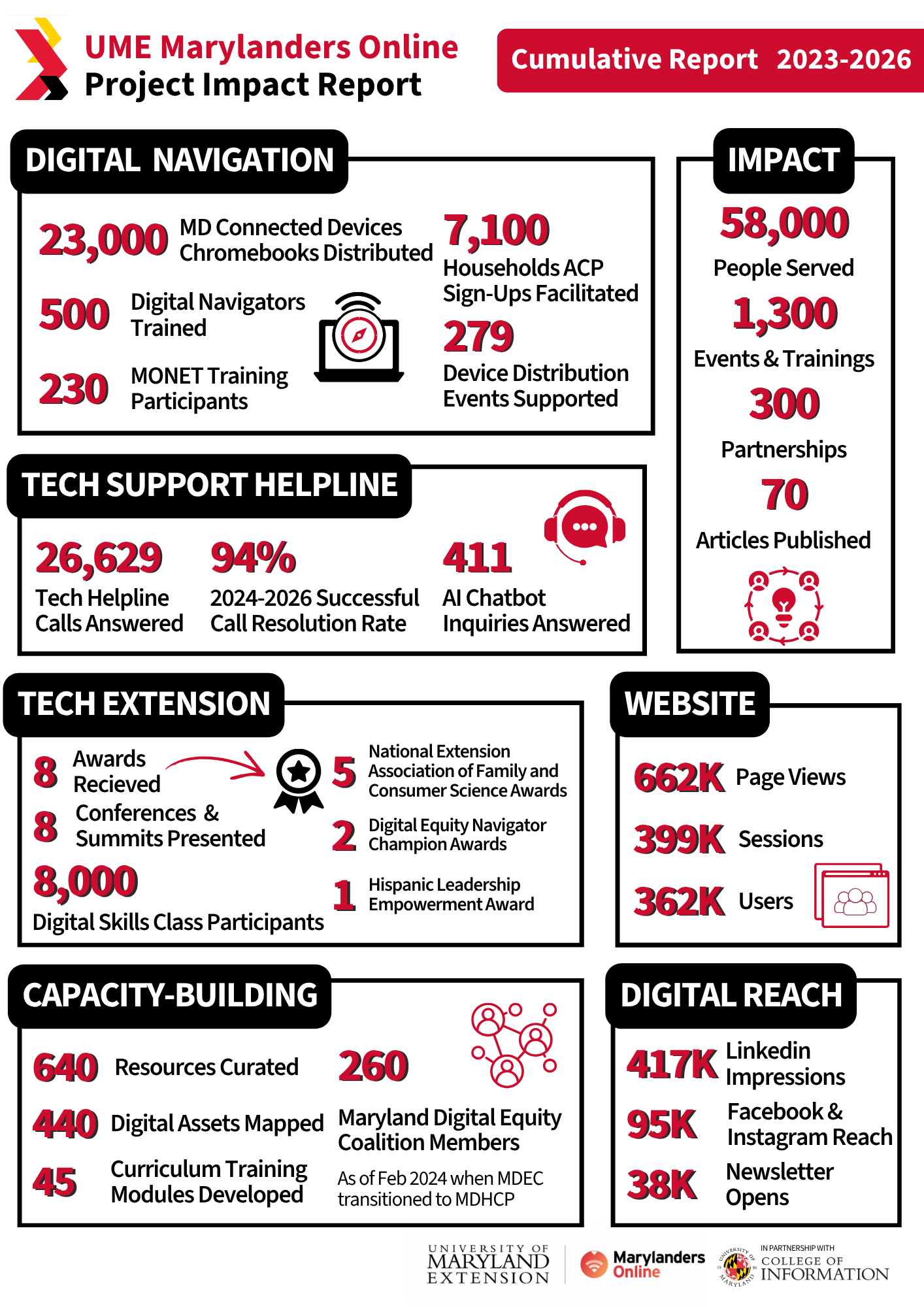
The Marylanders Online project served more than 58,000 people through 1,300 statewide events, workshops, and conferences. More than 8,000 people participated in digital skills classes, many of which were held at partner locations throughout the state, including libraries, museums, community and senior centers, schools, and other trusted community institutions.
The project’s communications and web team further amplified the reach of Marylanders Online programs and services. Between January 2022 and August 2026, the website generated 662,000 page views, 399,000 website sessions, and 362,000 users. Strategic social media and email marketing amassed a total digital audience of 2,223,857 impressions - 417,000 from LinkedIn, 95,000 through Facebook and Instagram, and 38,000 through the monthly newsletter.
The Marylanders Online project was also recognized locally and nationally, earning eight awards, including honors from the National Extension Association of Family and Consumer Sciences and the Digital Equity Navigator Champion Awards.
Digital Access & Connectivity Support
The Marylanders Online project team supported the distribution of 23,000 Chromebooks through the Maryland Connected Devices Program. The tech educator and digital navigation team also helped enroll 7,100 Maryland households in the Affordable Connectivity Program.
Digital Navigation Services
The Tech Support Helpline answered 26,629 calls and maintained a 94% successful call-resolution rate from 2023–2026. Developed by Marylanders Online and launched in March 2026, Mo the Terp-AI digital navigation assistant responded to 411 inquiries as of July 2026. Through partnerships and the bespoke Marylanders Online Navigator Empowerment Training (MONET) curriculum, Marylanders Online also trained 500 digital navigators, expanding regional capacity to build digital literacy at a local level.
Resources & Capacity Development
Beyond direct services, the Marylanders Online College of INFO curriculum team strengthened statewide capacity by curating nearly 700 website resources, mapping 440 statewide digital assets, and developing 45 learning modules.
Concluding Insights
The Marylanders Online program demonstrated how land-grant universities can address contemporary challenges through Extension education, research, and outreach. By treating digital literacy as an essential life skill and public good, the project created pathways for Maryland's most vulnerable populations to participate fully in digital society. Through strategic partnerships, innovative delivery methods, and commitment to accessibility, the Marylanders Online program has built a lasting impact of digital opportunities for current and future generations of Marylanders.